Staying Grounded in Uncertain Markets
Quick Take
Markets faced a more difficult start to 2026 as conflict with Iran, higher oil prices, and renewed inflation concerns led to the first meaningful pullback of the year.
The quarter also highlighted the value of diversification, as leadership shifted across asset classes, sectors, and regions.
In our view, the right response is not to attempt to predict every headline, but to stay focused on disciplined portfolio construction, risk management, and long-term goals.
Recent weeks have been a reminder of how quickly the investment landscape can change. Geopolitical tension, market volatility, and shifting expectations have left many investors asking what comes next. It is exactly in periods like these that a disciplined, long-term strategy becomes most valuable. With that in mind, we want to take a moment to reflect on the markets, the questions investors are asking, and the principles that continue to guide our approach.
The first quarter of 2026 was a reminder that markets do not move in a straight line and market pullbacks are normal.
After strong gains in 2025, investors began the new year with confidence. That changed quickly in late February, when conflict with Iran pushed oil prices higher, raised new inflation concerns, and led to the first meaningful market pullback of the year. After five weeks of bombing, there is still plenty of speculation and bluster about how the conflict will wind down. As of this now, the two sides have agreed to a two-week ceasefire. Will this turn into last peace and reopen the Hormuz Straight? The situation continues to evolve.
This is one of the many reasons we believe preparation matters more than prediction. Since the U.S. and Israel launched attacks on Iran, a basket of aerospace and defense companies has declined more than 7.5% through April 8th and has lagged the S&P 500. Markets often react before the full picture is clear. Headlines change quickly. Expectations shift quickly. A sound investment strategy should be built with that in mind.
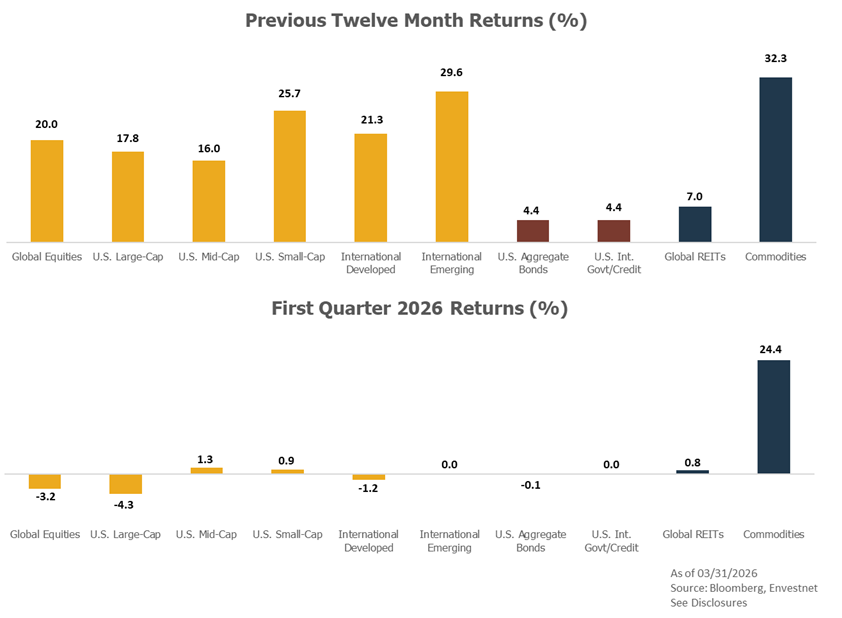
While the first three months of the year were challenging for investors, the quarter also reminded us why diversification remains so important. Large U.S. stocks struggled, while small- and mid-sized companies and international stocks outperformed. The dispersion of returns within large U.S. stocks was also significant. Software companies fell 24%, while energy stocks surged more than 37%. Commodities also moved sharply higher. Bonds were relatively steady, led by inflation-linked and floating-rate bonds. Different parts of the market responded in different ways, which is exactly why broad diversification continues to matter.
Taking a broader view, financial markets still performed well over the past twelve months. Global equities, measured by the MSCI All Country World Index, have gained 20% in dollar terms. Broad domestic bonds have returned 4.4%, outpacing inflation.
As we move into the second quarter, there are several open questions that will likely help determine the direction of the market for the rest of the year.
Is the Iranian Conflict Resolved?
The first is the conflict in Iran and what it could mean for oil prices. Higher oil prices can affect both consumers and businesses, and they can also put pressure on inflation. That matters because inflation will continue to influence the path of interest rates and Federal Reserve policy. If price pressures remain elevated, it could be harder for the Fed to lower rates as quickly as investors had hoped.
At the same time, the global economy is less dependent on oil than it was decades ago. This is not 1979. Higher energy prices can still create stress, but the impact may not be as severe or as lasting as many investors fear in the moment.
Is Private Credit Stress Isolated?
Private credit funds are drawing attention. Large redemption requests have forced several funds to restrict withdrawals, raising questions about liquidity and transparency in parts of that market. According to some reports, more than $4.6 billion in assets are now trapped behind redemption gates. This does not mean private credit is broadly broken, and it does not necessarily signal wider trouble. It does, however, remind investors that some investments can appear stable until market stress reveals their limits. That is why we continue to believe that understanding what you own, how it works, and how liquid it is remains essential.
Will AI Affect the Software Industry and Economy?
Another major question is how artificial intelligence will continue to affect the economy and the markets. AI is driving demand in areas such as semiconductors, power, and infrastructure. At the same time, it is creating uncertainty for some software companies, challenging previously sound business models, and raising broader questions about jobs, productivity, and competition.
It is natural for new technology to create both excitement and concern. History shows that major innovations often disrupt parts of the economy, but they also create new opportunities. Some companies will adapt well. Others may struggle. Over time, the strongest businesses are usually the ones that adapt, maintain defensible advantages, invest wisely, and continue to meet real needs.
There will be other concerns in the months ahead as well. Investors will continue to watch inflation, interest rates, trade policy, and politics. Some of these issues will prove important. Others may fade as conditions change. That is always the nature of investing.
What It All Means
For long-term investors, the key lesson is unchanged. We do not believe successful investing depends on predicting every headline or every short-term market move. It depends on having a plan that is built to weather a wide range of outcomes.
In times like this, portfolio construction matters. Diversification across asset classes, sectors, and regions matters. Risk management matters. Staying focused on long-term goals matters. These principles may not always feel exciting, especially when markets are being driven by dramatic news. But they remain some of the most reliable tools investors have.
Market volatility is never comfortable. But it is a normal part of investing. Our role is not to react to every shift in sentiment. It is to help clients stay grounded, stay prepared, and stay aligned with the goals that matter most to them. We remain focused on building thoughtful portfolios, managing risk carefully, and helping clients navigate uncertainty with clarity and confidence. While the headlines will continue to change, our commitment to disciplined planning and long-term stewardship will not.
Contact us at 865-584-1850 or info@proffittgoodson.com