Broadening the Horizons: What to do About Stock Market Concentration
Quick Take
39% of the S&P 500’s value is now held by just ten companies, and that share could go even higher after several anticipated blockbuster IPOs could enter the index.
Using an equal-weight strategy may combat concentration risk, but it brings higher fund fees and historically lower returns, while leaving the portfolio exposed to many of the same risk factors present across the U.S. large-cap market.
Broad equity diversification is best achieved by expanding the investment universe and incorporating new geographic and economic factors into the portfolio. This can be achieved by adding exposure to international equities, U.S. mid-cap & small-cap stocks, and real estate investment trusts (REITs).
The S&P 500 has long served as a cornerstone of the investment world, broadly representing a large portion of the U.S. stock market. However, increased concentration in a handful of large, tech-driven companies, such as Nvidia, Apple, and Microsoft, has raised doubts as to whether the index continues to function as a truly diversified benchmark. And if that was not enough, SpaceX, OpenAI, and Anthropic could soon join the index with possible record-setting IPOs later this year.
S&P 500 Composition
The S&P 500 is constructed on a floating market-cap weight basis, which simply means that larger companies get a proportionally larger share in the index. So when a company like Nvidia grows to nearly $5 trillion in valuation, it ends up with a very large share of influence in the index.
Equal-Weight Approach
One possible attempt to combat concentration risk is to invest in an equal-weight S&P 500 ETF, where each company is assigned the same weight regardless of size. While this approach reduces concentration, new concerns arise. Equal-weight strategies are less representative of the broader economy, typically carry higher costs from increased turnover and rebalancing, and have historically underperformed their market-cap weighted counterparts over long periods.
What Diversification Really Means
The primary objective of diversification is to reduce risk, which is not equivalent with just reducing concentration. In fact, having equal shares of companies like Apple ($4T valuation) and Domino’s Pizza ($11B valuation) can lead to performance that diverges meaningfully from both the stock market and the real-world economy.
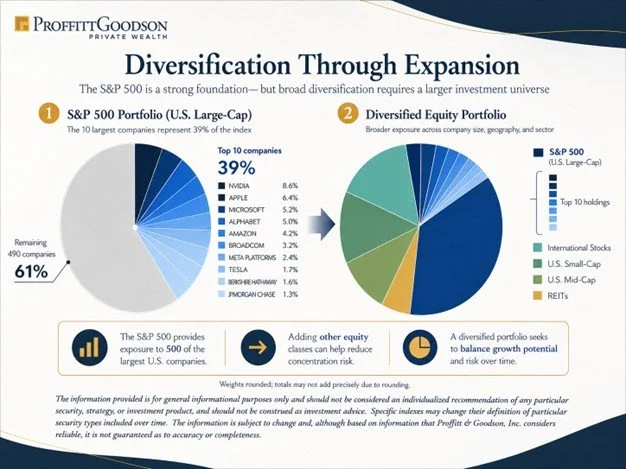
A more effective solution for improving diversification is to broaden the investment universe beyond the S&P 500. Incorporating allocations to international equities, U.S. mid-cap and small-cap stocks, and real estate investment trusts (REITs) introduces new geographic and economic factors for a more comprehensive portfolio.
Contact us at 865-584-1850 or info@proffittgoodson.com