Midterms & Markets
Quick Take
Historically, election outcomes and midterm-year volatility have had little lasting effect on market returns, which instead track economic fundamentals.
Instead, investors should focus on maintaining portfolio discipline and structure and avoiding the noise around election years.
There is a particular kind of investor confidence that seems to have less to do with valuations, earnings, or the yield curve, and more to do with who currently occupies the White House or Congress. It tends to rise when a preferred party wins. It tends to dip when the other side does. And it appears, on the evidence, to be only loosely connected to what actually happens in the financial markets.
That's worth keeping in mind as the November midterms come into view. A couple months out, the temptation to reposition a portfolio around a prediction of the outcome — or a hope for one — often starts to stir. It's a temptation that's probably worth resisting, and not primarily for reasons of civic virtue. It just hasn't tended to be a particularly reliable way to invest.
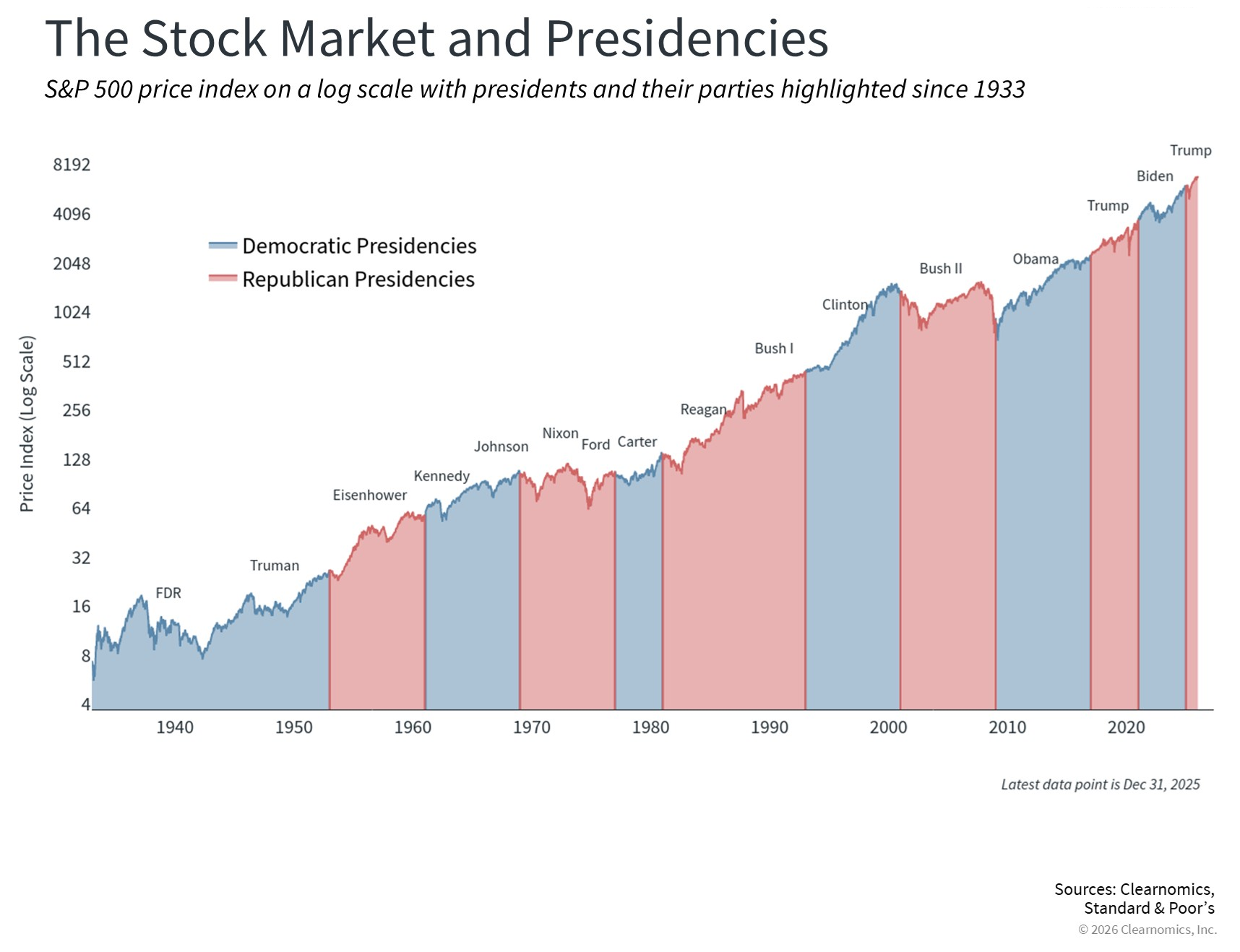
Surveys of consumer and investor sentiment have fairly consistently shown a partisan pattern: people feel better about the economy when their own party holds power, and worse when it doesn't — often regardless of what the economic data are actually doing. Market returns, though, haven't lined up with that pattern especially well. Average annual S&P 500 returns under recent Democratic and Republican administrations alike have run comfortably above the market’s long-run average. An investor who let political sentiment guide market exposure, stepping back during whichever administration felt less palatable, would likely have missed some of the better stretches in history. The market seems largely indifferent to political allegiances.
Then there's the midterm-year effect, which is real but easy to misread. Historically, returns in midterm years have tended to lag non-midterm years, with somewhat higher volatility. But it may be worth being cautious about attributing that to elections themselves. The two weakest recent midterm years — 2018 and 2022 — appear to have been driven less by ballot-box anxiety than by the Federal Reserve raising rates into a tightening cycle. Looking back further, to 2002, the more likely culprit was the unwinding of the dot-com bubble — a midterm year, but perhaps only by coincidence. The pattern can look electoral at a glance. The underlying mechanism often turns out to be monetary or fundamental instead.
What midterm years do seem to reliably offer is a shape. Returns have tended to be softer through much of the year (this year somewhat less so), followed by a historically strong fourth-quarter rally — one that has tended to start building in the weeks before election day, rather than after it. Markets, whatever else one makes of them, generally seem to dislike an open question more than they dislike any particular answer. Once the outcome becomes known, however it goes, the uncertainty premium has tended to come out of prices fairly quickly. That's arguably a reasonable case against trying to trade the event at all: by the time a conviction about the result has formed, the market may already be moving on from it.
Finally, there's the composition question — does the configuration of government actually matter much to returns? Divided government, unified government, a sweep for either party: equities and economic growth have generally managed to grind higher under all of them. That may not be especially surprising once you consider what tends to drive markets over a multi-year horizon — monetary policy, the health of the labor market, corporate earnings, and the valuations being paid for them. None of these appear to care much which party controls the federal government.
What It All Means
Elections shape plenty of things worth caring about. Portfolio construction, on the available evidence, doesn't seem to be one of them. Rates, earnings, and the underlying pace of growth appear to carry far more weight over time than whichever party happens to hold power. Staying invested through the noise has historically mattered more than guessing the outcome — a reminder that's easy to forget in the weeks before a vote, and easy to appreciate in the years after.
Contact us at 865-584-1850 or info@proffittgoodson.com