Taking a Look at Municipal Bonds
Quick Take
A season of high issuance and elevated U.S. Treasury rates has boosted municipal bond yields, while investor demand and municipal bond ETF investment flows have also been strong.
Municipal bonds may be issued by states, counties, school districts, utilities, universities, and various other entities for the purpose of general financing or specific projects.
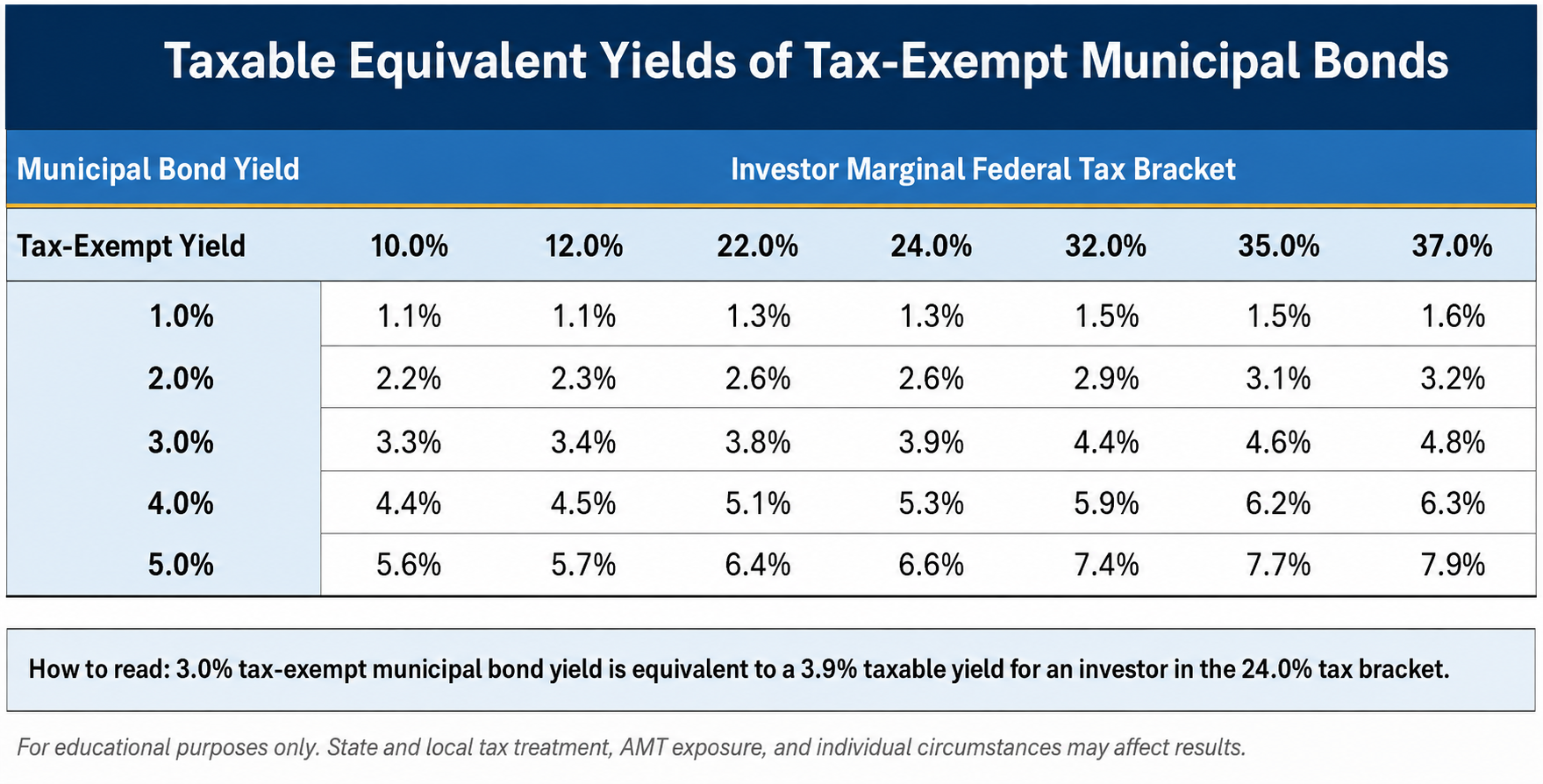
The interest earned on municipal bonds is often exempt from taxes, so it is important to consider the taxable equivalent yield, which is highest for investors in high tax brackets.
Municipal bonds offer unique opportunities for investors to play a part in financing local institutions and public projects within their home state or county.
Municipal Market Update
After years of limited market issuance, the municipal bond market is waking up. Following an initial resurgence of municipal issuance in 2025, Bloomberg reported $428B of gross bond issuance this year through August 24, with more scheduled to come. The rise in municipal bond supply along with higher U.S. Treasury rates has led to a notable increase in municipal bond yields since the start of 2026.
The growth in municipal bond issuance has been met with strong demand from investors. Exchange traded funds (ETFs) that invest in municipal bonds saw net investment flows of over $17B in the second quarter of 2026, compared to $8.8B in the prior year period according to Bloomberg.
Historically, periods of rising rates tend to be a drag on bond performance, as seen so far this year with the Bloomberg U.S. Aggregate Bond Index returning -0.3% through the end of August. However, for much of the year, the Bloomberg U.S. Municipal Bond Index outperformed the broader U.S. bond market and were up over 2% at the end of June. Weaker demand in July led to the municipal market return falling to just 0.2% at the end of August.
What Are Municipal Bonds?
Often overlooked in comparison to Treasuries or corporate bonds, the municipal bond market includes a diverse group of entities, from state and local governments to water utilities, transportation authorities, hospitals, school districts, universities and more.
Municipal bonds also vary greatly in the purpose they serve and how they are repaid. Many bonds issued by states are known as general obligation bonds (GOs) and are backed by the taxing authority of the issuer. Such bonds may be issued for general financing or specific projects, such as community parks, road improvements, or facilities specific to the issuer. Another type of municipal bond is a revenue bond, where interest and principal payments are linked directly to the revenue an issuer generates through their operations. Revenue sources for payments can include tolls run by transportation agencies, university tuition, or revenue from the operations of a hospital or utility.
The Tax Advantage
What makes municipal bonds truly unique is that the interest investors earn is often exempt from state and federal income tax. While there are exceptions (some municipal bonds are not tax-exempt for various reasons), investors do not have to pay any taxes on the income they earn from many of the bonds in the municipal market. One important distinction is that the state tax exemption only applies for bonds that are issued in the investors home state.
Evaluating Taxable Equivalent Returns
When it comes to tax-exempt municipal bonds, an important consideration is the taxable-equivalent yield (i.e. the yield a taxable bond must have to provide an equivalent after tax return). As demonstrated in the chart below, a municipal bond with a 3% tax-exempt yield has a taxable equivalent yield of 3.9% for investors in the 24% tax bracket, but a taxable equivalent yield of 4.8% for investors in the highest bracket. This distinction makes municipal bonds an ideal investment for high income individuals, and much less appropriate for investors who are subject to lower tax rates.
The Risks
As with any asset class, municipal bonds possess certain risks. Most municipal bonds are assigned credit ratings that evaluate the financial strength of the issuer and any embedded credit enhancements. However, even highly rated bonds have the potential to default on payments to investors if the issuer is unable to generate sufficient cash. It is important to understand who is responsible for paying back a municipal bond and what sources of revenue are intended to be used for payments. Holding a diverse portfolio of municipal bonds can help protect investors from the risk of an issuer defaulting.
The municipal market is in general less liquid than the U.S. Treasury market, which makes it more difficult to exit some municipal bond positions prior to maturity. If an investor needs to sell a bond that trades infrequently, they may have to sell at a discount to entice a buyer. Having a long-term investment mindset can help mitigate the effects of lower market liquidity.
What It All Means
The municipal bond market is growing, and yields have been steadily rising this year. Taxable equivalent returns of municipal bonds may be attractive for investors subject to high tax rates but not so much for investors in lower tax brackets. Municipal bonds offer the unique opportunity to invest in local institutions and development projects that investors might witness firsthand, but many municipal bonds trade less frequently than Treasury bonds and are not backed by the federal government. It is important to weigh these factors along with other considerations when evaluating the municipal bond market.
If you are interested in learning more about the characteristics of municipal bonds or current market conditions, please let us know.
Contact us at 865-584-1850 or info@proffittgoodson.com