SpaceX IPO: Exciting Company, Difficult Price
Quick Take
On June 12, investors will be able to purchase shares of SpaceX through its initial public offering (IPO) at an expected company valuation of $1.77T ($135 per share) according to Bloomberg.
While SpaceX has been the leader of innovation in rocketry and satellite connectivity, its third business segment focused on AI has trailed industry leaders in terms of model capability.
Historically, IPO returns have underperformed over extended periods after entering the market. It is important to be aware of the likely volatility of an IPO of this size
One of the most innovate and influential startups of all time is about to go public at a record valuation, but is now the right time to buy? According to Bloomberg, SpaceX is expected to enter the public market at a $1.77T valuation ($135 per share), which would make it the 8th largest company in the world by market capitalization. The company has revolutionized the space industry with its rapid technological development, but even the most compelling company should be bought at a fair price.
A Look Under the Hood
One of the challenges of investing in any IPO is the limited financial history. SpaceX describes its three distinct operating segments in its S-1 filing, and the biggest money maker may surprise investors.
Space
Rocket launching and space travel endeavors are what most people associate with the SpaceX name. Over the past decade, SpaceX has pioneered space innovation, introducing reuseable rockets and greatly reducing the cost of launch. Through government and commercial contracts, SpaceX generated over $4B of revenue in 2025.
Starlink (Connectivity)
In conjunction with the space segment, Starlink operates the world’s largest fleet of satellites, providing high speed internet services around the world, including on boats and airplanes. While launching rockets certainly generates the most attention for SpaceX, Starlink is actually the core operating segment of the company, generating over $11B of revenue in 2025.
xAI
Just a few months prior to its IPO, SpaceX acquired xAI, another of Elon Musk’s businesses, which features the Grok AI chatbot, several data centers providing AI compute, and the X social media platform. While yet to earn a profit, SpaceX claims that the AI business has the highest potential for growth across its three segments.
Data Centers in Space?
One of the more extraordinary claims made by SpaceX is that it intends to launch orbital data centers in 2028. While such a feat is feasible, currently the cost of launch, and the complexity of cooling in space makes orbital data centers highly impractical. But as SpaceX continues to improve the cost effectiveness of rocket launch, orbital data centers may become a real cost advantage if AI compute demands continue to grow.
Will SpaceX Show Up in Your Retirement Account?
Despite talk of SpaceX drastically reshaping index funds and retirement accounts, in reality the impact will be very minimal. The S&P 500 index still requires at least 12 months of trading after an IPO before a company can be included, though a new rule for the Nasdaq-100 index allows SpaceX to be added in just 15 days. Additionally, SpaceX will have a much lower index allocation than its market cap would imply, due to only 5% of shares initially being available for trading.
What Past IPOs Tell Us
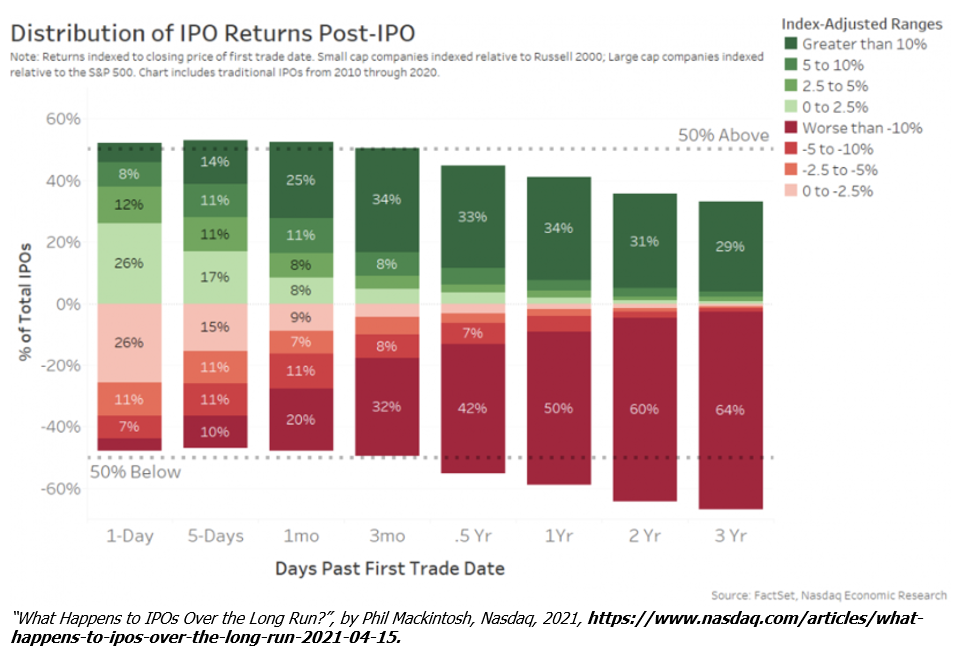
Historically, many IPO companies will have an initial price surge followed by an extended period of underperformance. According to a 2021 Nasdaq report, 64% of IPOs underperform index returns by at least 10% in the three years following the initial offering. IPO valuations are often boosted by investor exuberance, leaving little room for price appreciation.
Unlike stocks that have years of trading history, IPOs enter the market at predetermined prices that have not been formed by the market. SpaceX’s initial market value will be $1.77T. The company may post sales of around $24B in 2026, implying a Price to Sales ratio of 74x. A valuation multiple of this magnitude will require a tremendous amount of growth to pay off.
All in all, it’s easy to feel the allure of owning shares of a company that may one day build a colony on Mars. The upside for massive growth is certainly there, but so is the risk that the true valuation may be overstated in the IPO price.
Contact us at 865-584-1850 or info@proffittgoodson.com