Bond Market Tantrum
Quick Take
Rising Treasury yields mainly reflect a strong economy, a credible Fed and a reshuffling of buyers rather than inflation fears, so after this year’s losses high-quality bonds once again offer handsome income worth building into in stages.
This year’s gains have come from earnings growth rather than richer valuations, and they are broadening beyond the AI giants across sectors, company sizes and regions, giving diversified investors a sound footing even with higher bond yields.
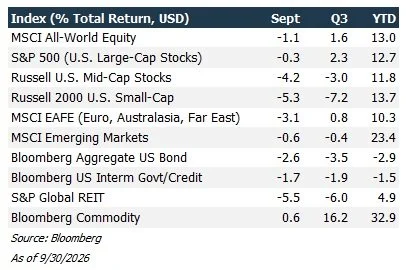
Domestic stocks stand near record highs, even as the bond market threw a tantrum in the third quarter. In the quarter, the yield on ten-year Treasuries jumped by 80 basis points to close at 5.2%, its loftiest level in roughly two decades. Borrowing costs in Britain, France, Germany and Japan followed it upward.
Global stocks returned 2% in the third quarter and are up 13% so far this year. U.S. bonds, by contrast, fell 3.5% in the quarter from rising yields, leaving them down 2.9% year to date. Rising rates also weighed on U.S. small caps, which lean more heavily on floating-rate borrowing; they fell 7% in the quarter, though they remain solidly up 14% on the year.
The causes of rising yields vary by country, but in America they are, for one part, the price of a strong economy rather than the symptom of a sick one. For patient investors they are also, at long last, an invitation: high-quality bonds once again pay investors solid income to own them.
The Return of (Real) Income
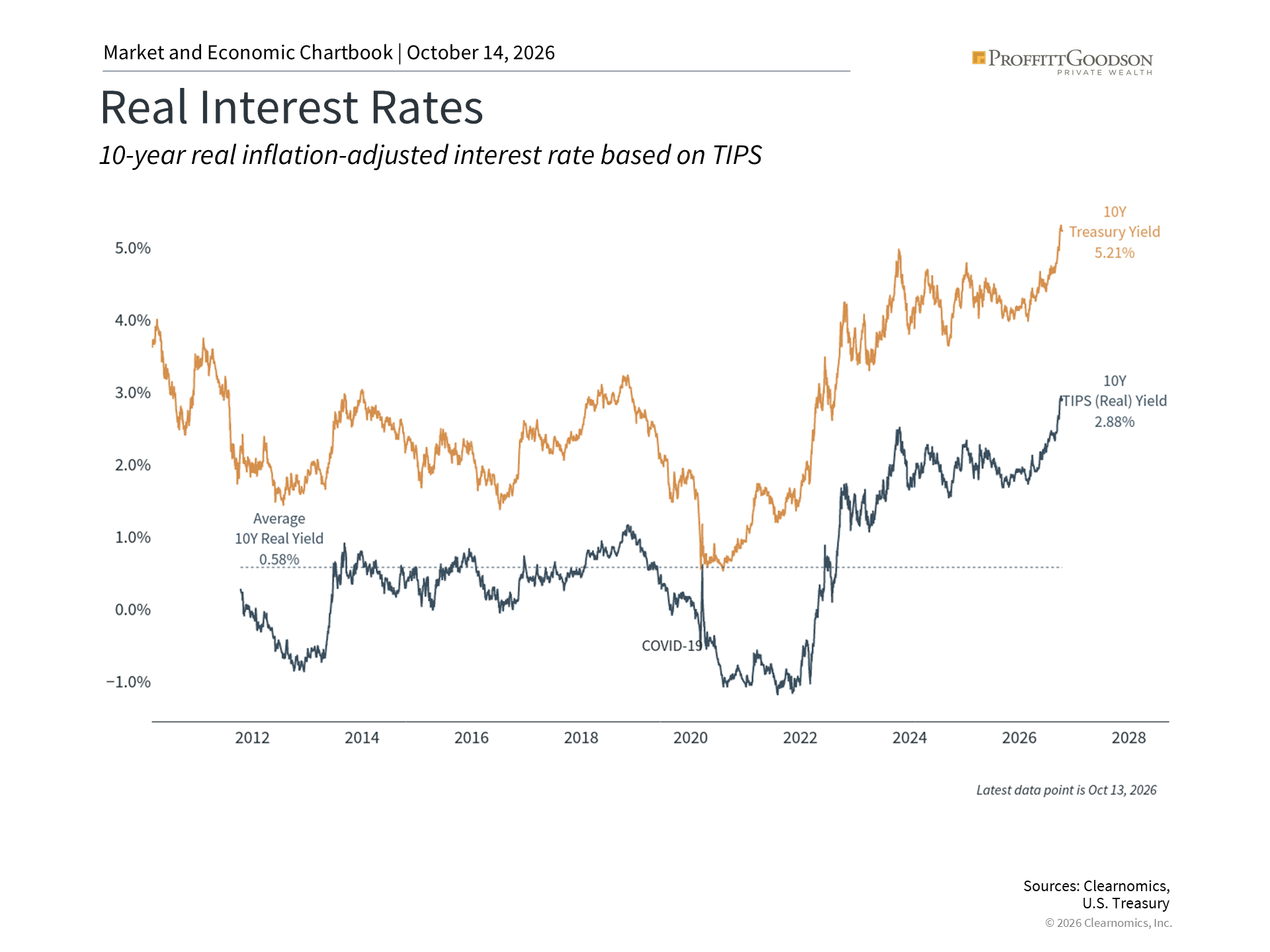
Behind the rise in yields lies strength and strain. Real yields, the return after expected inflation, are higher, while market expectations of inflation itself have barely budged. Since the beginning of the year, the ten-year yield has risen from 4.2% to 5.2%, while the market’s inflation expectations have held steady near 2.3%. A combination of factors have led to higher real yields.
The first is growth. Layoffs remain scarce, consumers are still spending freely and corporate profits are swelling; the Atlanta Fed’s nowcast has third-quarter real growth running at an annualized 3.6%. Bond investors, in other words, are not paying up for protection against inflation. They are demanding a richer real return for lending to an economy that is expanding briskly, and that AI may yet make more productive. If it does, the return on capital will rise, and the rates that go with it.
The second is the Fed. Inflation is running at 3% on its preferred PCE measure and oil above $100 a barrel is not helping. Under Kevin Warsh, the Fed raised rates in September, and investors expect at least two more increases by March 2027. Fed resolve to keep policy tighter for longer lifts the path of short-term rates investors anticipate, and with it yields along the whole curve. That the market trusts the hikes to work is a mark of the Fed’s credibility, and the reason inflation expectations have held steady.
The third is structural. Rich-world governments are borrowing heavily (America’s deficit is around 6% of GDP) and the AI build-out competes with Treasuries for investors’ cash. Meanwhile, some reliable buyers are stepping back. The Fed is letting its bond holdings run off, rising yields in Japan and Europe give foreign investors less reason to buy Treasuries, and defined-benefit pension funds are shrinking. Their place is being taken by nimbler hedge funds, which demand more compensation. The term premium, the extra return for lending long, is at its highest in over a decade.
For a borrower this is painful; for a lender it is welcome. After a decade in which savers were paid next to nothing, a ten-year Treasury Inflation-Protected Security (TIPS) now offers a real yield of around 3%, among the most generous in nearly two decades.
Earning Their Keep
Artificial intelligence still sets the tempo for the stock market, but the third quarter brought a reshuffling. Investors rotated back into software and services firms, once written off as AI’s likely casualties and now showing signs that they can harness the technology rather than be undone by it. Chipmakers, the boom’s earliest winners, slipped. Technology remains among the year’s best-performing sectors, up 28%, bested only by energy, up 40% on the back of costly oil.
The boom is not confined to the tech titans. The “Magnificent Seven” have returned 14% this year, but so have the remaining 493 companies in the index. Small-cap stocks are still outperforming their larger counterparts after stumbling this quarter. Nine of the S&P 500 index’s 11 sectors are in positive territory for the year, while international stocks continue to deliver strong returns in more cyclical sectors.
Nor is this year’s gain built on froth. The ten largest companies in the S&P 500 now account for roughly 40% of the index. But that weight is earned, because those same ten companies generate 40% of the index’s earnings.
Importantly, returns so far have come chiefly from robust earnings growth across economic sectors, while valuation multiples have contracted. The pattern is global, holding in America, the euro zone and Japan, across international markets more broadly and in emerging markets. Profits rising faster than prices is a healthy sort of market rally: three quarters in, shares trade on lower multiples than they did in January.
Valuations have fallen even as markets have risen, because profits have outrun share prices. Higher long-term yields shrink the present value of future profits, and with Treasuries offering a competitive return, stocks must offer more earnings per dollar to compete. Further, investors have declined to extrapolate today’s boom, pricing in a reversion to more ordinary earnings growth in the years ahead.
That restraint is itself a source of strength: with expectations modest and valuations lower than at the start of the year, the market has room to keep rewarding companies that keep delivering.
The Wealth Effect
Beneath the market, the economy remains resilient. The share of domestic industries whose output is growing is in line with its 20-year average, employment is expanding across a typical number of sectors, and that breadth has been improving since last year. The consumer, not the data center, remains America’s engine: household spending added 2.5 percentage points to real annualized growth in the second quarter, more than the whole of the economy’s growth.
AI investment matters, but less than the hype suggests. One Fed estimate credits the boom with around 0.6 percentage points of annual growth: useful, but hardly the difference between expansion and recession. Its subtler influence runs through wealth.
Households’ assets have swelled by some $34trn since ChatGPT launched, according to the Federal Reserve, and stocks now make up a record share of household assets. That wealth helps keep consumers spending; some estimates suggest it accounts for roughly a third of the growth in consumption.
AI matters to domestic growth, though less through the data centers than through the stock market at this juncture: its largest contribution so far has come from the wealth it has created, not the capital it has deployed. Yet AI is not carrying the economy alone. Steady employment, sound household balance sheets and retirees drawing on their savings all lend the expansion foundations of its own. AI is an accelerant, which makes for a sturdier expansion than the headlines suggest.
What It All Means
This year has handed investors a rare opportunity. Stocks stand near record highs, while bonds pay a meaningful income. For portfolios that have drifted heavily towards stocks on the back of strong gains, now is a good moment to rebalance, taking some profits from stocks and putting them to work in high-quality bonds.
Stocks remain the engine of long-term growth. Profits are rising, valuations have come down and gains are spreading across sectors, company sizes and regions, so shares deserve their place. But bonds no longer need to be tolerated for safety alone. Starting yields, historically a good indicator of a bond’s return over time, are now high enough to provide both income and a comfortable cushion should markets stumble.
None of this rules out bumps. A disorderly bond market or a sharp reversal in AI enthusiasm would test investors’ nerves. But selling some shares at strength to buy bonds that finally pay their way leaves a balanced portfolio on firmer ground than it has stood in years.
As always, we would be glad to discuss how these views apply to your own circumstances.
Contact us at 865-584-1850 or info@proffittgoodson.com